
Driving Digital Modernization Across Legacy Infrastructure
Driving Digital Modernization Across Legacy Infrastructure
Modernizing a Legacy AngularJS Platform into an Accessible React System, Driving 40% Efficiency Gains and 60% Faster Development
Modernizing a Legacy AngularJS Platform into an Accessible React System,
Driving 40% Efficiency Gains
+40%
User Efficiency
+60%
Development Speed
AA
Accessibility Score
+40%
User Efficiency
+60%
Development Speed
AA
Accessibility Score
CLIENT
Government Agency
Government Agency
PROJECT TYPE
Enterprise Migration
Enterprise Migration
TIMELINE
1 year
1 year
TEAM SIZE
12
12
ROLE
UX Lead
UX Lead
DESIGN TOOLS
Figma, Storybook, Mural, New Relic,
Matomo
Figma, Storybook, Mural, New Relic,
Matomo
STRATEGY
Project Management
UX Strategy
UI Design
UX Outcomes
Research
Accessibility
PROJECT OVERVIEW
PROJECT OVERVIEW
Built on a depreciated AngularJS framework and an early-generation design system, our enterprise application struggled with poor accessibility, inconsistent interactions, outdated UIs that reduced productivity, and frustrated users. Technical debt continued to increase while security risks grew and attracting developers to maintain the legacy stack became increasingly difficult.
THE CHALLENGE
THE CHALLENGE
The transition from AngularJS to React presented a significant challenge. Team members were required to modernize the platform while simultaneously delivering new features under strict deadlines. Because React-ready components were not always available, developers sometimes relied on legacy AngularJS code to ship new UI updates quickly, which slowed the migration and increased UX and technical debt.
THE PROBLEM STATEMENT
THE PROBLEM STATEMENT
As a designer, I want to accelerate the transition from AngularJS to React while teams continue to deliver new features under strict deadlines by establishing reusable components and patterns that allows developers to build new UIs in React instead of relying on legacy AngularJS implementations.
"Each time we touched the legacy code, we uncovered more accessibility issues and more technical debt. It felt like we were patching problems instead of moving the product forward."
"Each time we touched the legacy code, we uncovered more accessibility issues and more technical debt. It felt like we were patching problems instead of moving the product forward."
Quality Impact - QA Lead
THE OUTCOME AND IMPACT: Delivering Measurable Success Across
Key Metrics
UX Improvements
Task Completion Rate
Support Requests
First Time Task Success
Error Rate
+40%
-25%
+20%
-30%
Development
Development Speed
Bug Reports
Deployment Time
Duplicated UI Code
+60%
-45%
+35%
-46%
Accessibility
WCAG compliance
Color Contrast
Keyboard Navigation
Screen Reader Support
AA
4.5:1
100%
100%
Key Insights
Key Learnings that Shaped UX
Discovery Sets the Foundation to Success
Discovery ensures the team fully understand the legacy functionality, technical restraints, and user flows before the migration.
A Well Defined Phased Approach Works
Setting clear goals and timelines helps keep everyone on track.
Collaboration Accelerates Adoption
Engaging all stakeholders early on was imperative for success.
What's Next
Expanding the Design System
Extend the library components across 5 additional products.
Usability Testing
Conduct usability testing on new components to refine interaction patterns.
Having centralized styling with CSS variables has made testing significantly better. Updates are predictable and we are no longer firefighting styling issues every release. Our QA team can focus on validating real functionality.
Quality Impact
-QA Lead
KEY ACHIEVEMENTS
Beyond the metrics, we established a scalable design foundation that enables more consistent user experiences and faster product development.
Migrated 60+ components and patterns
Reduced Technical Debt by 40%
Achieved 100% feature parity during
transition
Improved page load speeds by 3x
Established a design system for future growth
Established design system used across
5 products
THE PROCESS: Our Four-Phased That Shaped Success
By following a four-phase migration strategy, we modernized our platform from AngularJS to React without disrupting development momentum.
Discovery and Audit
Thorough evaluation of the
current system, user feedback,
and technical limitations.
200+ hardcoded styles across components
85+ duplicate color values
What We Found
Component Catalog
Pattern Inventory
Accessibility Audit
Code Review
Design System Planning
Building a modern, accessible
component library without disrupting established user workflows.
Created a modern, accessible design library while preserving familiar workflows to ensure smooth adoption.(Components that would be used in upcoming UI implementations were given the highest priority to accelerate development and
reduce bottlenecks.)
Updating style guidelines
Updated accessibility guidelines
Implemented design variables
Migration Strategy
Executing a phased rollout to
minimize disruption while ensuring a consistent
and reliable user experience.
Defined a clear phased migration roadmap to minimize disruption while maintaining a consistent user experience.
Determined a clear testing strategy
Determined a clear rollback plan
Implementation
A collaborative development
process guided by continuous user
feedback and accessibility validation.
Translated AngularJS components to React framework
Completed user testing
Capture system and user performance data
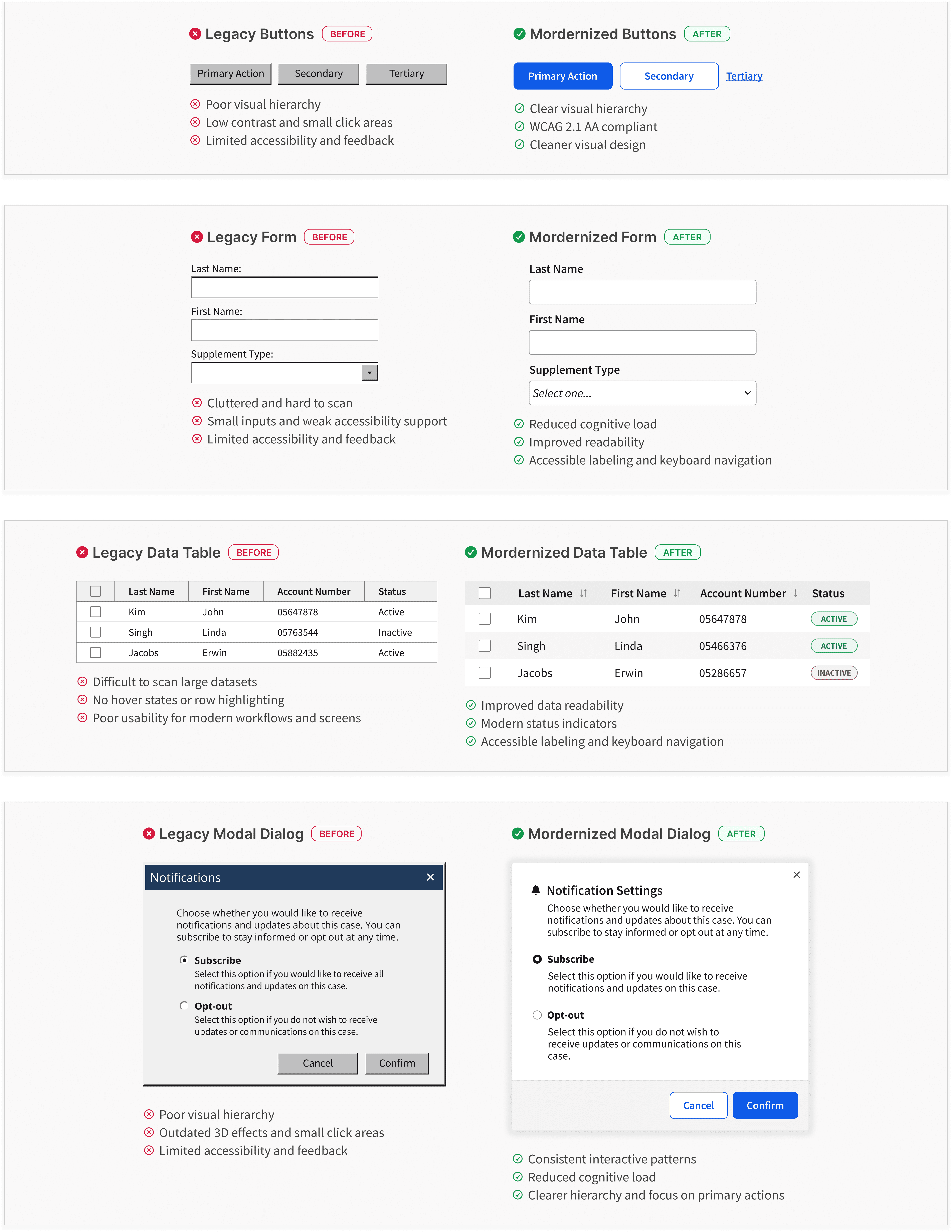
DESIGN SYSTEM MAKEOVER: Before and After
See how we turned outdated UI framework into accessible, enjoyable experiences for today's users.
THE PROCESS: Our Four-Phased Strategy That Shaped Success
By following a four-phase migration strategy, we modernized our platform from AngularJS to React without disrupting development momentum.
Discovery and Audit
Discovery and
Audit
Thorough evaluation of the
current system, user feedback,
and technical limitations.
Thorough evaluation of the
current system, user feedback,
and technical limitations.
Component Catalog
Pattern Inventory
Code Review
Accessibility Audit
What We Found
90+ Accessibility risks
20+ Outdated workflows
20+ Outdated user workflows
90+ Accessibility risks
Component Catalog
Pattern Inventory
User Journey Maps
Technical Assessment
Accessibility Audit
What We Found
90+ Accessibility risks
20+ Outdated user workflows
Code Review
Accessibility Audit
What We Found
Design System Planning
Building a modern, accessible
component library without disrupting
established user workflows.
Building a modern, accessible
component library without disrupting established user workflows.
Created a modern, accessible design library while preserving familiar workflows to ensure smooth adoption.(Components that would be used in upcoming UI implementations were given the highest priority to accelerate development and
reduce bottlenecks.)
Updated accessibility guidelines
Updating style guidelines
Implemented design variables
Created a modern, accessible design library while preserving familiar workflows to ensure smooth adoption.(Components that would be used in upcoming UI implementations were given the highest priority to accelerate development and
reduce bottlenecks.)
Updating style guidelines
Updated accessibility guidelines
Implemented design variables
Migration Strategy
Executing a phased rollout to
minimize disruption while ensuring a consistent and reliable user experience.
Defined a clear phased migration roadmap to minimize disruption while maintaining a consistent user experience.
Defined a clear testing strategy
Determined a clear rollback plan
Testing & Implementation
A collaborative development
process guided by continuous user feedback and accessibility validation.
Translated AngularJS components into the React framework
Completed user testing
Capture system and user performance data
Migration Strategy
Executing a phased rollout to
minimize disruption while ensuring a consistent and reliable user experience.
Defined a clear phased migration roadmap to minimize disruption while maintaining a consistent user experience.
Determined a clear testing strategy
Determined a clear rollback plan
Implementation
A collaborative development
process guided by continuous user feedback and accessibility validation.
Translated AngularJS components into React framework
Completed user testing
Capture system and user performance data
DESIGN SYSTEM MAKEOVER: Before and After
See how we turned outdated UI framework into accessible, enjoyable experiences for today's users.

OUTCOME AND IMPACT: Delivering Measurable Success Across Key Metrics
UX Improvements
Task Completion Rate
Task Completion Rate
Support Requests
Support Requests
First Time Task Success
First Time Task Success
Error Rate
Error Rate
+40%
+40%
-25%
-25%
+20%
+20%
-30%
-30%
Development
Development Speed
Development Speed
Bug Reports
Bug Reports
Deployment Time
Deployment Time
Duplicated UI Code
Duplicated UI Code
+60%
+60%
-45%
-45%
+35%
+35%
-46%
-46%
Accessibility
WCAG compliance
WCAG compliance
Color Contrast
Color Contrast
Keyboard Navigation
Keyboard Navigation
Screen Reader Support
Screen Reader Support
AA
AA
4.5:1
4.5:1
100%
100%
100%
100%
Having centralized styling with CSS variables has made testing significantly better. Updates are predictable and we are no longer firefighting styling issues every release. Our QA team can focus on validating real functionality.
Quality Impact
-QA Lead
KEY ACHIEVEMENTS
Beyond the metrics, we established a scalable design foundation that enables more consistent user experiences and faster product development.
Migrated 60+ components and patterns
Migrated 60+ components and patterns
Reduced Technical Debt by 40%
Reduced Technical Debt by 40%
Achieved 100% feature parity during transition
Achieved 100% feature parity during transition
Improved page load speeds by 3x
Improved page load speeds by 3x
Established a design system for future growth
Established a design system for future growth
Established design system used across 5 products
Established design system used across 5 products
KEY INSIGHTS: Key Learnings that shaped uX
Discovery Sets the Foundation to Success
Discovery ensures the team fully understand the legacy functionality,
technical restraints, and user flows before the migration.
Discovery Sets the Foundation to Success
Discovery ensures the team fully understand the legacy functionality, technical restraints, and user flows before the migration.
A Well Defined Phased Approach Works
Setting clear goals and timelines helps keep everyone on track.
Collaboration Accelerates Adoption
Engaging all stakeholders early on was imperative for success.
What's Next
Expanding the Design System
Extend the library components across 5 additional products.
Usability Testing
Conduct usability testing on new components to refine interaction patterns.
Quicker Developer Onboarding
Created Single Source of Truth,
Reduced feature specific UI rebuilds